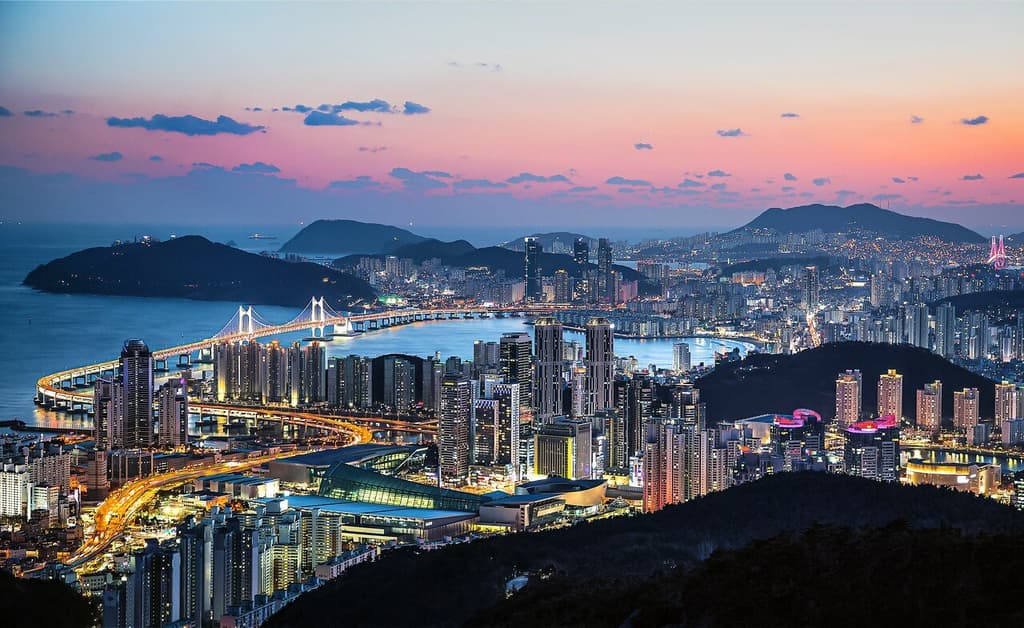
**Persistent dominance of the North Pacific high-pressure system is sustaining hot, humid conditions across southern South Korea into late August 2026, driving trader expectations toward peak temperatures of 35–36°C in Busan on August 25.** Official forecasts and recent Korea Meteorological Administration guidance indicate daytime highs of 31–35°C nationally, with Busan (influenced by maritime air but still under the high’s edge) likely seeing strong solar heating under mostly clear to partly cloudy skies, light southerly or variable winds, and high humidity that limits nighttime cooling but supports daytime maxima. Historical August averages near 29.5°C and records up to 37.3°C provide context, but the current pattern—marked by expanded subtropical high influence and minimal frontal activity—has produced consecutive days above 32°C, with sensible temperatures often exceeding actual readings. The tight clustering between 35°C and 36°C reflects uncertainty in fine-scale factors such as exact cloud fraction, boundary-layer mixing, or minor steering shifts that could add or subtract 1–2°C. Model consensus remains stable for the immediate period, though updated runs and any localized shower development could refine outcomes before resolution. Traders are weighting the established heatwave persistence more heavily than longer-term seasonal decline.
Experimental AI-generated summary referencing Polymarket data. This is not trading advice and plays no role in how this market resolves. · UpdatedHighest temperature in Busan on August 25?
Highest temperature in Busan on August 25?
35°C 41%
36°C 37%
37°C 11%
34°C 9%
29°C or below
<1%
30°C
<1%
31°C
<1%
32°C
1%
33°C
3%
34°C
9%
35°C
41%
36°C
37%
37°C
11%
38°C
2%
39°C or higher
2%
35°C 41%
36°C 37%
37°C 11%
34°C 9%
29°C or below
<1%
30°C
<1%
31°C
<1%
32°C
1%
33°C
3%
34°C
9%
35°C
41%
36°C
37%
37°C
11%
38°C
2%
39°C or higher
2%
The resolution source for this market will be information from NOAA, specifically the highest reading under the "Temp" column for all times on this day, available here: https://www.weather.gov/wrh/timeseries?site=rkpk
To toggle between Fahrenheit and Celsius, click the "Switch to Metric Units" button until the relevant table displays °C.
This market can not resolve until the first data point for the following date has been published on the resolution source.
The resolution source for this market measures temperatures to whole degrees Celsius (eg, 9°C). Thus, this is the level of precision that will be used when resolving the market.
Revisions to temperatures recorded within this market's timeframe will be considered until the first datapoint for the following date has been published, after which any alterations will not be considered.
Market Opened: Aug 23, 2026, 12:58 AM ET
Resolution Source
https://www.weather.gov/wrh/timeseries?site=rkpkResolver
0x69c47De9D...The resolution source for this market will be information from NOAA, specifically the highest reading under the "Temp" column for all times on this day, available here: https://www.weather.gov/wrh/timeseries?site=rkpk
To toggle between Fahrenheit and Celsius, click the "Switch to Metric Units" button until the relevant table displays °C.
This market can not resolve until the first data point for the following date has been published on the resolution source.
The resolution source for this market measures temperatures to whole degrees Celsius (eg, 9°C). Thus, this is the level of precision that will be used when resolving the market.
Revisions to temperatures recorded within this market's timeframe will be considered until the first datapoint for the following date has been published, after which any alterations will not be considered.
Resolution Source
https://www.weather.gov/wrh/timeseries?site=rkpkResolver
0x69c47De9D...**Persistent dominance of the North Pacific high-pressure system is sustaining hot, humid conditions across southern South Korea into late August 2026, driving trader expectations toward peak temperatures of 35–36°C in Busan on August 25.** Official forecasts and recent Korea Meteorological Administration guidance indicate daytime highs of 31–35°C nationally, with Busan (influenced by maritime air but still under the high’s edge) likely seeing strong solar heating under mostly clear to partly cloudy skies, light southerly or variable winds, and high humidity that limits nighttime cooling but supports daytime maxima. Historical August averages near 29.5°C and records up to 37.3°C provide context, but the current pattern—marked by expanded subtropical high influence and minimal frontal activity—has produced consecutive days above 32°C, with sensible temperatures often exceeding actual readings. The tight clustering between 35°C and 36°C reflects uncertainty in fine-scale factors such as exact cloud fraction, boundary-layer mixing, or minor steering shifts that could add or subtract 1–2°C. Model consensus remains stable for the immediate period, though updated runs and any localized shower development could refine outcomes before resolution. Traders are weighting the established heatwave persistence more heavily than longer-term seasonal decline.
Experimental AI-generated summary referencing Polymarket data. This is not trading advice and plays no role in how this market resolves. · Updated
Beware of external links.
Beware of external links.
Frequently Asked Questions